










A clear breakdown of what Brainforge fixes, how fast, and what it actually delivers.
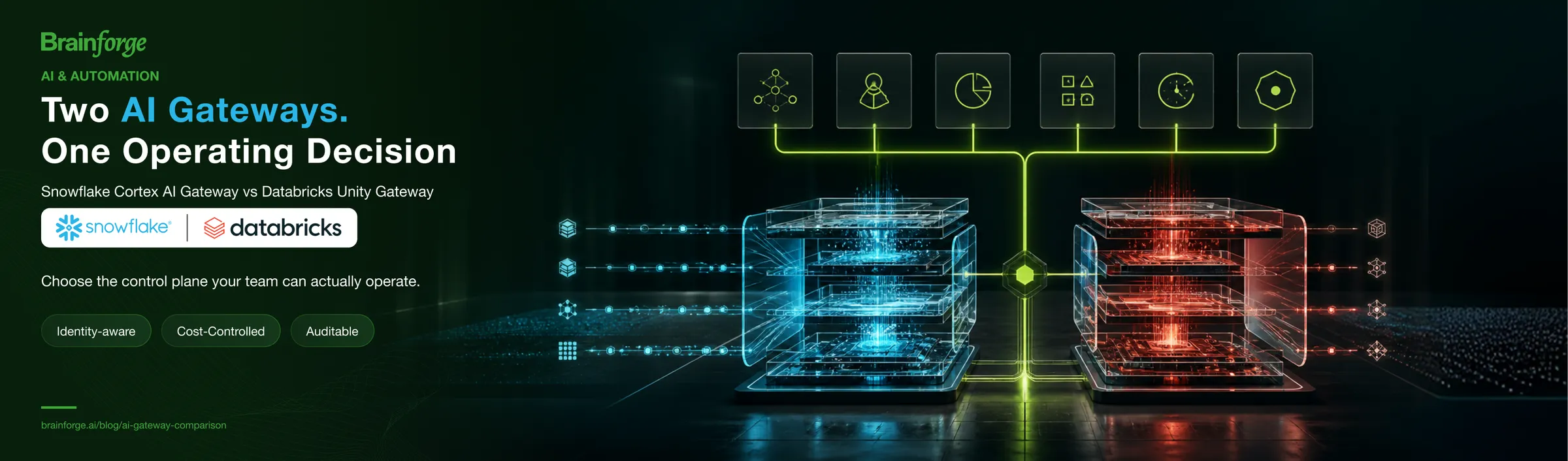
AI governance has moved from architecture diagram to operating problem. In the first week of August 2026, Databricks announced the general availability of Unity AI Gateway, while Snowflake's Cortex AI Gateway and its surrounding agent-governance capabilities became the center of a parallel release cycle.
That creates a practical question for teams already building agents: do you need a new gateway, and if so, which control plane should own it?
Don't pick the longer feature list. Start with where your trusted data, identities, model calls, and operational ownership already live.
What an AI gateway should control
An AI gateway sits between applications or agents and the models and tools they call. At minimum, it should help a team answer:
- Which models and endpoints can be called?
- Which users, services, or agents are allowed to call them?
- How much is each workload spending?
- What data or tools can an agent reach?
- What happened when an agent took an action?
- Can a platform owner stop or change a workload without editing every application?
Neither gateway removes the need for application-level authorization, data classification, evaluations, or human review. A gateway is a control point, not a complete AI operating model.
The short version
Choose Snowflake Cortex AI Gateway when your center of gravity is Snowflake: your models, governed data, usage accounting, and security operations already run there, and you want centralized controls close to the warehouse and Cortex workloads.
Choose Databricks Unity AI Gateway when your center of gravity is the Databricks data and AI platform: you want governance across model endpoints, agents, MCP servers, and other AI assets managed through Unity Catalog and Databricks workspace controls.
Use both when your organization genuinely runs both platforms. In that case, define one enterprise policy above the gateways. Do not let each platform become the source of truth for identity, spend, and incident response.
Decision table
| Question | Snowflake Cortex AI Gateway | Databricks Unity AI Gateway |
|---|---|---|
| Best starting point | Snowflake-first teams using Cortex and warehouse-native AI | Databricks-first teams using model serving, agents, MCP, and Unity Catalog |
| Primary architectural advantage | Governance close to Snowflake data, Cortex workloads, and Snowflake usage | Governance across a broad set of AI assets in the Databricks control plane |
| What to test first | Model allowlists, spend limits, cost attribution, agent identity, auditability | Endpoint and asset policy, identity propagation, model/tool controls, auditability |
| Main risk | Assuming Snowflake controls every agent call in a heterogeneous stack | Assuming catalog governance alone solves application authorization and data leakage |
| Dual-platform concern | Conflicting identity, budgets, and logs | Conflicting identity, budgets, and logs |
Treat this table as a starting hypothesis. Validate the exact controls available in your account, edition, region, and release channel before committing to a design.
Five tests before you choose
1. Can you name every model call?
Inventory calls by application, agent, model, environment, owner, and data classification. If you cannot produce that inventory, a gateway deployment will give you more logs without giving you control.
Start with a 30-day sample. Separate interactive analyst use from production workflows. They have different owners, budgets, and tolerance for interruption.
2. Can you attribute spend to a business owner?
A single platform bill is not cost governance. Require attribution by team, application, agent, environment, and model. Set a budget or alert before the first production launch, not after an unexpected bill.
3. Can you revoke an agent without finding its developer?
Test the kill path. Disable a model, credential, endpoint, or agent identity and confirm how long it takes to stop calls. Then test the recovery path. Governance that only works during business hours is not an operating control.
4. Can you reconstruct an action?
A prompt log is not an audit trail. For any consequential workflow, capture the request, identity, model or tool used, relevant policy decision, output, downstream action, and reviewer or approval state. Redact sensitive data while retaining enough context for investigation.
5. Can the platform policy follow the workload?
Agents move. A prototype becomes a scheduled job; an internal assistant gains write access; an MCP server gets added to an existing workflow. Test whether policy travels with the workload or must be rebuilt in each application.
A practical rollout sequence
Week 1: inventory. List models, agents, endpoints, tools, identities, owners, data classes, and business-critical actions. Mark unknowns explicitly.
Week 2: baseline. Measure request volume, cost, latency, error rate, and human intervention for each important workload. Decide what "good" means before enforcing limits.
Week 3: guardrails. Start with model allowlists, environment separation, least-privilege identities, spend alerts, and action logging. Avoid a broad deny policy that teams immediately route around.
Week 4: controlled production. Put one valuable workflow behind the chosen gateway. Review blocked requests, false positives, cost attribution, and incident response. Expand only after the owner can explain both normal and abnormal behavior.
Recommendation
For most mid-market teams, the first decision is not "Snowflake or Databricks?" It is "where can we establish a policy that the team will actually operate?" Choose the platform with the strongest existing ownership, identity coverage, and data context. If that answer differs by workload, keep both gateways, but centralize the policy vocabulary, ownership model, and review cadence.
The gateway is the easy part. The harder part is deciding which agent may do what, with which data, at what cost, and who is accountable when it does something unexpected.
If you are choosing a control plane for Cortex, Unity Catalog, or a dual-platform agent stack, Brainforge's Snowflake practice and AI workflows team help operators put those controls into production. Reach out to start a conversation.