
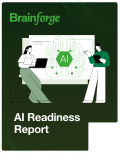
A clear breakdown of what Brainforge fixes, how fast, and what it actually delivers.
MCP server design
Architecture for tools, resources, and prompts that fit your systems and security model.
Model Context Protocol is how AI agents get real access to your tools and data. Brainforge designs and builds MCP servers with the security, scoping, and observability that make agent tool access production-safe.
In plain terms
Where teams get stuck
Agents can't reach our systems because there's no safe tool layer.
We're worried about giving agents access without control.
MCP servers are built ad-hoc with no security or observability.
No standard for how agents should access tools.
What we deliver
Architecture for tools, resources, and prompts that fit your systems and security model.
Production MCP servers with scoped permissions, authentication, and observability.
Connect MCP servers to your agents, assistants, and IDEs with governance and review.
How deep it goes
The same delivery primitives (context, controls, and review) show up across every engagement.
Design of tools, resources, and prompts that fit your systems.
Production servers with proper auth, error handling, and observability.
Least-privilege access and audit so agents act within bounds.
Connect MCP servers to agents, assistants, and IDEs.
Standards and review so agent tool access scales safely.
What changes
Proof in production
Related ways to engage
Common questions
Engagements start with a scoped build sprint, so you pay for a bounded piece of work rather than an open-ended retainer. Most teams begin with one system or tool, then expand as the pattern is proven.
A Model Context Protocol server is a standard way to give AI agents access to tools, data, and workflows with defined interfaces. It is how agents reach your systems safely.
Every tool is scoped to least privilege, authenticated, and audited. Agents only get the access the workflow needs, and everything they do is observable.
Yes. We build servers that connect to your CRM, docs, tickets, data, and internal APIs, with the auth and governance your stack requires.
A first production server with scoped tools and observability typically ships in 2–4 weeks of sprint work.
How we work
We identify the tools and data agents should reach and the permissions each needs.
We build servers with scoped access, auth, and observability, wired to your agents.
We standardize access, document, and hand over the operating model.
Our Trusted Partners





Proof next to the ask






Not sure which engagement fits? See how we scope and price the work →
In one working session we'll name what's broken, what's possible, and the first system worth building.



Press Esc to close