










A clear breakdown of what Brainforge fixes, how fast, and what it actually delivers.
If you've ever woken up at 2 AM because an Airflow DAG failed silently, you already understand the fundamental problem with traditional data pipeline orchestration: it was built for a world where humans were the only reliable operators.
That world is changing fast.
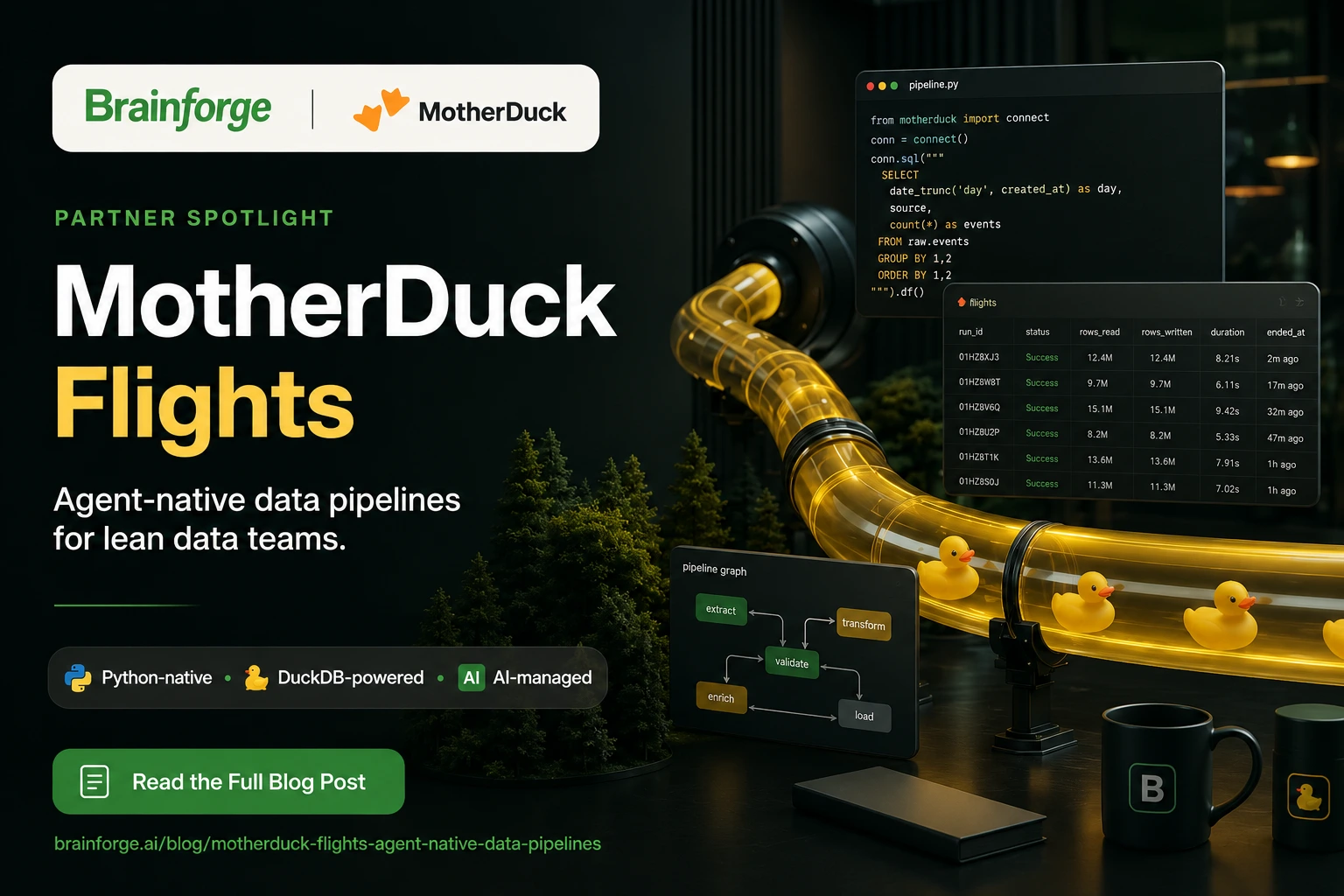
MotherDuck, the cloud analytics company built on top of DuckDB, just launched Flights, a new Python-based pipeline framework designed from the ground up to be built, run, and managed by AI agents. Paired with Dives, MotherDuck's agent-built interactive visualization feature, it's a quiet but significant bet: that the next generation of data infrastructure won't be operated by data engineers alone, but by AI agents working alongside them.
This post breaks down what Flights actually is, how it compares to existing orchestration tools, and where Brainforge sees it fitting in a mid-market data stack.
What Is MotherDuck Flights?
Flights is MotherDuck's answer to a growing frustration: modern data pipelines are too complex for small teams to operate at scale, but too important to leave unattended.
At its core, Flights lets you define data pipelines as Python code, not YAML, not a visual DAG editor, not a proprietary DSL. Pure Python. This matters for one reason above all others: AI agents like Claude and Cursor can read, write, and modify Python natively.
The result is a pipeline framework where:
- Engineers write the initial pipeline logic in Python
- AI agents can extend, debug, and refactor that logic autonomously
- MotherDuck's cloud runtime handles scheduling, execution, and scaling
- DuckDB's analytical engine powers the actual data transformations
Flights also integrates natively with MotherDuck's existing catalog and sharing features, meaning pipelines run against the same tables your analysts are already querying. No new infrastructure to spin up.
How Does It Compare to Traditional Orchestration?
The honest answer: Flights isn't trying to replace Apache Airflow or Dagster for teams that need them. Enterprise-scale orchestration with complex dependency graphs, custom operators, and SOC 2 audit trails will still live in purpose-built orchestration platforms.
But for the majority of mid-market data teams, Airflow is significantly over-engineered. Here's how the tradeoffs actually break down:
Apache Airflow
Airflow is the industry default for a reason. It's battle-tested, extensible, and has a massive ecosystem. But it comes with real overhead: you're managing Python dependencies, executor configurations, metadata databases, and a web server just to run scheduled SQL. For teams without a dedicated platform engineer, this overhead compounds fast.
Dagster
Dagster introduced a more developer-friendly model with asset-centric thinking and native testing support. It's excellent for teams building mature data platforms. The learning curve and infrastructure requirements, however, are still substantial for a 3–5 person data team.
MotherDuck Flights
Flights trades raw configurability for operational simplicity. The win is real for teams that:
- Live primarily in DuckDB / MotherDuck for analytics
- Want to move fast without a dedicated DevOps or platform engineering function
- Are actively experimenting with AI-assisted development and want pipelines that agents can actually touch
The trade-off is ecosystem maturity. Flights is new, and the community and tooling around it will take time to catch up to Airflow's decade-long head start.
What Does "Agent-Native" Actually Mean?
This phrase gets thrown around a lot right now. In the context of Flights, it means something specific.
Traditional pipeline frameworks were designed for human operators. Configuration is stored in YAML or proprietary formats that are difficult for AI models to reason about systematically. Debugging requires navigating complex UIs. Making changes requires understanding implicit conventions that exist only in someone's head.
Flights pipelines are just Python modules. An AI agent can:
- Read the full pipeline definition without any special tooling
- Identify failures by inspecting run logs and tracing back to the responsible function
- Propose fixes as code changes that a human can review before applying
- Generate new pipelines from a plain-English description of what data should move where
- Test changes against a local DuckDB instance before deploying
At Brainforge, we've been piloting agent-assisted pipeline work using Cursor and Claude on client engagements. The workflow that's emerged: a data engineer describes the transformation logic in natural language, the agent scaffolds the pipeline code, the engineer reviews and approves, and the agent handles boilerplate like error handling and logging. Time to first working pipeline drops significantly. Time spent debugging drops even more.
Flights is the first purpose-built framework that leans into this workflow rather than fighting it.
A Simple Example: Building an Ingestion Pipeline with an Agent
Here's a simplified look at what a Flights pipeline definition looks like, and why it's agent-friendly.
Start with a plain English prompt to your AI agent of choice:
"Create a MotherDuck Flights pipeline that reads raw order data from our S3 bucket every hour, filters for orders from the last 7 days, computes revenue by SKU, and writes the result to a summary table in our MotherDuck database."
The agent can scaffold the full pipeline as a Python module, using DuckDB's S3 integration, MotherDuck's connection API, and Flights' scheduling decorators. The output is reviewable Python code, not a black-box configuration file.
That's the unlock. Engineers stay in control of logic and review, while agents handle the tedious parts of pipeline construction and maintenance.
Where Brainforge Sees Flights Fitting
We're actively exploring Flights for clients who meet a specific profile:
- Mid-market companies (50–500 employees) without a dedicated platform engineering team
- Teams already using MotherDuck or DuckDB for analytics or exploratory work
- Organizations experimenting with AI-assisted development where reducing the agent's cognitive overhead on non-Python formats is valuable
For these clients, Flights can meaningfully reduce pipeline operational burden. We're also exploring it as a lighter-weight alternative to full Airflow deployments for clients in the early stages of building out a data function, a way to get real pipelines running without the infrastructure commitment.
As part of our active MotherDuck co-sell partnership, we'll be developing reference architectures and migration guides over the coming months. If you're evaluating Flights for your team, we'd love to share what we're learning.
The Bigger Picture
Flights isn't just a new pipeline tool. It's a signal about where data infrastructure is heading.
The teams winning with data right now aren't the ones with the most engineers. They're the ones who've figured out how to amplify a small team with AI. That means building on foundations that AI agents can actually work with: readable code, clear interfaces, and tools that don't require specialized knowledge to operate.
MotherDuck is making a clear bet that agent-native infrastructure is the future of the mid-market data stack. Based on what we're seeing in client work, we think they're right.
If you want to explore what an agent-native data stack could look like for your team, reach out; we're actively building this out with clients now.