











A clear breakdown of what Brainforge fixes, how fast, and what it actually delivers.
Most organizations already record, route, and report on calls. The missing layer is understanding what happened inside them.
A call is often the richest first-party signal in the funnel: intent, urgency, service need, objections, location, budget, and whether the conversation ended in a booked appointment. Yet those signals frequently remain trapped in audio files, agent notes, or a CRM activity log that says only “called.”
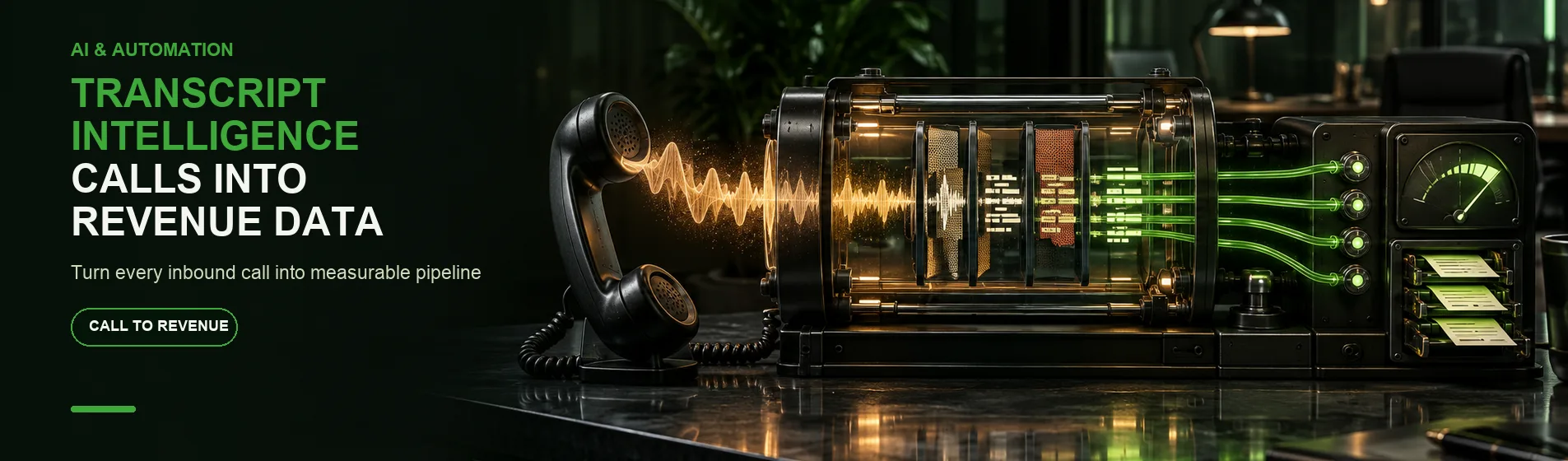
Transcript intelligence turns the conversation into structured, reviewable revenue data. It is not a replacement for a good rep. It is the feedback loop that lets marketing, operations, and sales see what the phone channel is actually producing.
The phone channel is a revenue system hiding in plain sight
For home-services businesses especially, phone calls remain a high-intent conversion path. Invoca’s 2025 Home Services Call Conversion Benchmarks analyzes more than 60 million calls and frames the operating question correctly: not just how many calls marketing generated, but how effectively teams answered, qualified, and converted them.
CallRail’s home-services benchmarks likewise report that phone calls remain a primary contact method, while missed calls and unrecognized numbers create measurable leakage. Treat those figures as directional vendor benchmarks—not universal truths—but the pattern is durable: paid demand can be lost after the click, at the moment the phone rings.
What transcript intelligence adds
- Lead classification: Separate new opportunities, existing-customer service calls, spam, recruiting, and out-of-area requests.
- Qualification signals: Extract service type, urgency, location, budget cues, insurance status, and buying stage.
- Outcome tracking: Detect booked appointments, estimates requested, callbacks promised, no-sale reasons, and unresolved calls.
- Coaching evidence: Surface missed questions, pricing objections, compliance language, and moments where a rep could have advanced the conversation.
- Attribution context: Connect the call to campaign, landing page, keyword, or referring source so spend can be evaluated against qualified outcomes.
From audio to a revenue-ready record
A useful pipeline has four stages:
- Capture: Collect the recording and metadata—caller, timestamp, tracking number, source, location, and consent status.
- Transcribe: Generate a searchable transcript, with speaker separation and redaction rules for sensitive information.
- Structure: Convert the conversation into a consistent schema: intent, qualification, outcome, next action, confidence, and supporting excerpt.
- Activate: Push the result into the CRM, reporting layer, coaching queue, or alert workflow. A score nobody uses is only a prettier archive.
Start with a small, explicit label set. “Qualified lead,” “appointment booked,” and “follow-up required” are usually more useful in week one than a model that attempts to infer 40 nuanced emotions.
The metrics that connect calls to the P&L
Move beyond call volume. Track answer rate, qualified-call rate, appointment-set rate, show rate, close rate, revenue per qualified call, time to follow-up, and reason-for-no-sale. Segment each by source, location, service line, daypart, and team.
This is where transcript intelligence earns its keep: it lets you explain why a channel or branch is outperforming, not just that it is. For example, two campaigns may generate the same number of calls; one creates emergency-service appointments while the other produces price shoppers. The operational response should differ.
A practical 30-day starting plan
- Week 1: Define three to five business outcomes and a shared call-label schema with marketing, operations, and sales.
- Week 2: Sample calls across sources, branches, and outcomes. Manually label a baseline before automating.
- Week 3: Validate transcript accuracy, redaction, confidence thresholds, and CRM write-back rules.
- Week 4: Launch one workflow—such as a daily missed-opportunity queue—and compare performance with the baseline.
Guardrails matter
Call data can contain health, financial, and personally identifying information. Define consent and retention policies, restrict access by role, redact sensitive fields where appropriate, and keep a human in the loop for consequential decisions. Use model outputs as evidence and triage—not as an unreviewed verdict on a customer or employee.
The shift: from “we track calls” to “calls drive decisions”
The value is not the transcript itself. The value is a closed loop between what customers say, what teams do next, and what the business earns. Once the organization can reliably connect conversation patterns to appointments, revenue, and coaching actions, the phone becomes measurable operating data rather than an opaque cost center.
Brainforge helps teams design the data model, QA the signals, and connect conversation intelligence to the systems where decisions already happen. Talk to us about your call data.